

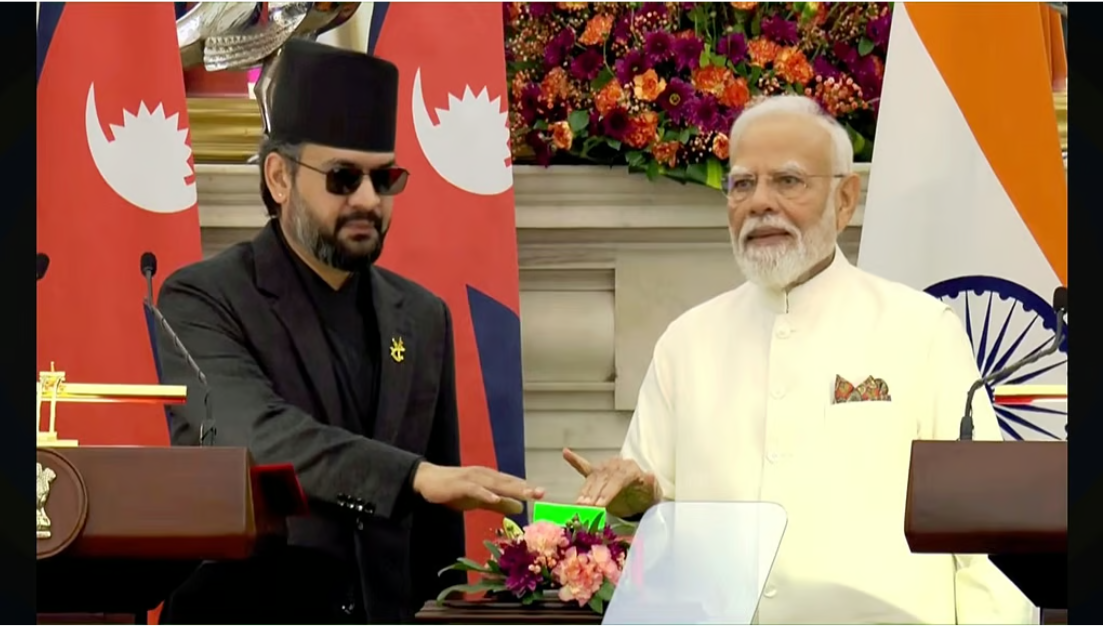
Prime Minister Narendra Modi on Monday announced an economic package worth NPR 24,000 crore for Nepal and flagged off a cross-border passenger train with Nepalese Prime Minister Balendra Shah. The two sides also finalised a joint vision document and signed eight agreements to deepen bilateral cooperation.
The announcements came during Shah’s first bilateral foreign visit to India since taking office in March. The two leaders discussed a wide range of issues, including trade, connectivity, energy, development cooperation and the long-standing boundary dispute.
India-Nepal Economic Package and Development Assistance
Modi reaffirmed India’s support for Nepal’s development journey and announced a development cooperation package worth NPR 24,000 crore (approximately ₹15,000 crore).
The package comprises grant assistance of NPR 5,600 crore (₹3,500 crore) for post-earthquake reconstruction and new infrastructure projects, along with a Line of Credit of NPR 18,400 crore (₹11,500 crore) for energy sector projects.
Modi also expressed condolences over the loss of lives caused by the devastating floods that struck Nepal in August. He said the assistance would support reconstruction, create new opportunities and strengthen Nepal’s capacity to respond to future disasters.
India-Nepal Connectivity and Transit Trade
Improving cross-border connectivity and facilitating Nepal’s transit trade featured prominently in the discussions. India announced that it would facilitate access to Deendayal Port in Kandla, Gujarat, for Nepal’s transit cargo. Access to Paradip Port in Odisha will also be provided after the required infrastructure work is completed.
The two leaders flagged off the inaugural Sarayu-Kamala Express rail service between Ayodhya in Uttar Pradesh and Janakpur in Nepal. The service is expected to improve connectivity and support religious and cultural tourism along the Ramayana Circuit. Both sides also agreed to explore similar connections to develop Buddhist and Shiv-Shakti religious tourism circuits.
The leaders virtually inaugurated a cross-border motorable bridge between Dharchula in India and Darchula in Nepal. They also laid the foundation stone for a new Integrated Check Post (ICP) at Banbasa and reviewed progress on ICPs at Bhairahawa, Sunauli and Dodhara-Chandani.
Energy and Infrastructure Cooperation
Energy cooperation remained another key area of discussion. The two leaders dedicated Phase II of the Motihari-Amlekhgunj petroleum pipeline to the people of Nepal and laid the foundation stone for a petroleum terminal in Jhapa.
They also emphasised the need to begin work on the Siliguri-Jhapa petroleum pipeline at the earliest and agreed to explore cooperation in constructing gas pipelines between the two countries.
Both sides welcomed progress in hydropower cooperation and the participation of Indian companies in projects in Nepal. The leaders virtually laid the foundation stone of the 669 MW Lower Arun Hydro-Electric Project and agreed to support the timely completion of hydropower projects being developed by Indian companies.
Vision Document and Eight Agreements
Modi and Shah adopted a joint vision document titled Viksit Bharat and Samunnat Nepal: Re-imagining the Partnership. It outlines a roadmap for cooperation in economic and development partnerships, energy, water resources, connectivity, climate resilience, disaster management, technology and health.
The document also identifies opportunities for collaboration in sports, start-ups, digital services, space and innovation. The two leaders expressed confidence that the shared vision would translate into tangible outcomes for both countries.
The eight agreements signed during the visit cover areas including forensic sciences, health, sustainable urban development and fisheries.
India also announced plans to establish an offshore campus of the Indian Institute of Technology in Nepal, a Start-up Incubator and an Innovation Hub. Modi said India would expand scholarship opportunities for Nepali students in law and technology and cooperate in developing an Agro-Industrial Park to promote food processing and value addition.
India and Nepal Discuss Outstanding Boundary Issues
The two prime ministers directed their respective foreign secretaries to work on resolving outstanding boundary issues. They also noted progress in joint fieldwork related to the maintenance and repair of boundary pillars.
The discussions come amid recent strains in bilateral relations following Shah’s remarks in May seeking the involvement of China and the United Kingdom in addressing the long-standing border dispute. India had rejected any role for third parties, maintaining that the issue should be addressed through the established bilateral mechanism.
At a media briefing, Foreign Secretary Vikram Misri said the two leaders also discussed the regional situation and international issues. He added that people-to-people ties received special attention during the talks, with cricket also featuring in the discussions.
Shah described Nepal-India relations as being founded on mutual respect, trust and goodwill. He also invited Modi to visit Nepal.
The visit has outlined a broad agenda for India-Nepal cooperation, covering development assistance, trade, connectivity, energy, technology and people-to-people engagement.