


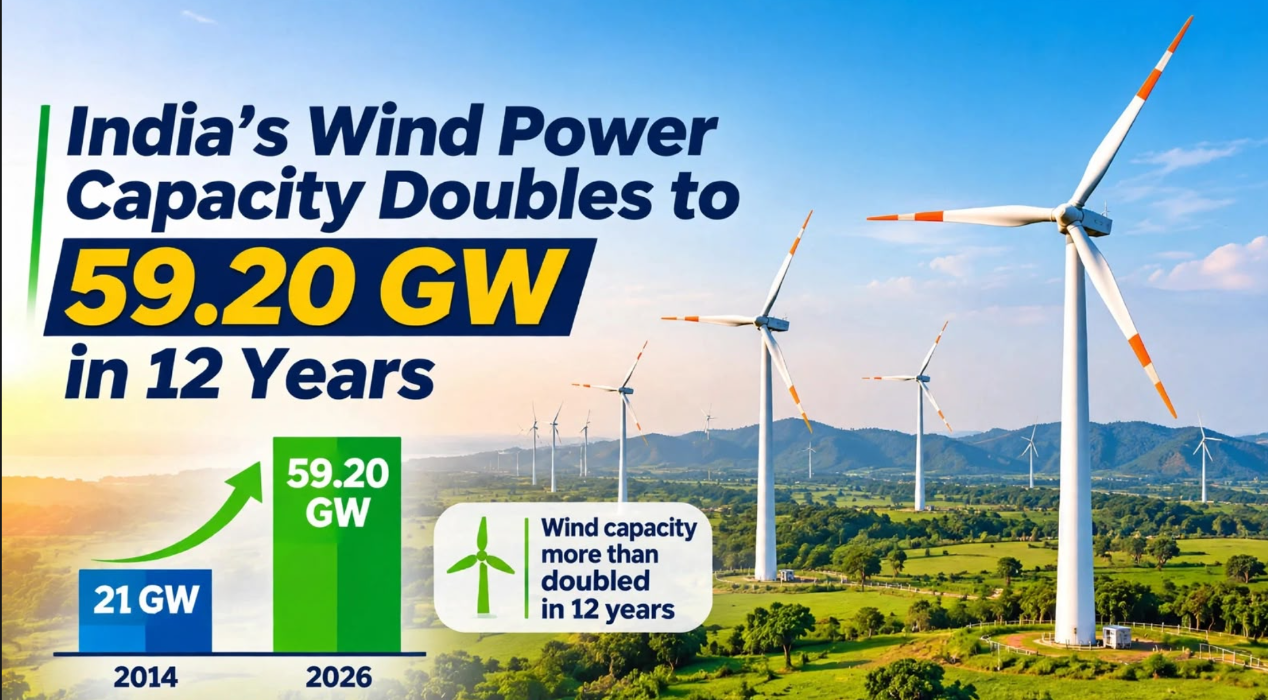
India’s installed wind power capacity has more than doubled over the past 12 years, increasing from 21 GW to 59.20 GW, reflecting the country’s expanding renewable energy sector and transition towards cleaner power sources.
According to an official factsheet issued on Wednesday, India ranks fourth globally in installed wind power capacity. Wind energy accounts for approximately 19.8% of the country’s total installed renewable energy capacity of 299.25 GW.
The government is targeting 100 GW of installed wind power capacity by 2030 and 156 GW by 2036, supported by new projects, investment incentives and policy reforms.
India Has Vast Wind Energy Potential Across Eight States
India has substantial untapped wind energy resources. Its estimated gross wind power potential stands at 695.5 GW at 120 metres and 1,163.9 GW at 150 metres above ground level.
India’s wind energy potential is distributed across eight states, with Rajasthan accounting for the highest potential at 284.2 GW. Gujarat follows with 180.8 GW, Maharashtra with 173.9 GW, Karnataka with 169.3 GW and Andhra Pradesh with 123.3 GW. The estimated potential stands at 95.1 GW in Tamil Nadu, 55.4 GW in Madhya Pradesh and 54.7 GW in Telangana.
To identify suitable locations for wind energy development, the National Institute of Wind Energy (NIWE) has installed more than 900 wind-monitoring stations across the country.
Wind potential maps have also been developed at hub heights of 50 metres, 80 metres, 100 metres, 120 metres and 150 metres to support resource assessment and project planning.
₹6,853 Crore Support for Offshore Wind Projects
The government is focusing on expanding wind energy deployment, developing offshore wind projects and modernising the electricity grid.
A major initiative is the ₹6,853 crore Viability Gap Funding (VGF) scheme for 1,000 MW of offshore wind energy projects. The planned capacity is divided equally between the coasts of Gujarat and Tamil Nadu, with 500 MW earmarked for each state.
The government has also launched a 500 MW pilot project under the Contracts for Difference (CfD) mechanism. This arrangement is designed to reduce price volatility and provide greater revenue certainty to renewable energy developers.
These initiatives aim to support investment in offshore wind infrastructure and encourage participation in the emerging sector.
Government Introduces Wind Energy Policy and Regulatory Reforms
Alongside financial support, the government has undertaken several measures to address challenges affecting wind energy development.
A Task Force constituted in January 2026 is examining regulatory, land, transmission and implementation-related issues in the sector.
Other measures include:
- Green Energy Open Access Rules: Facilitate direct procurement of renewable electricity by industries.
- Approved List of Models and Manufacturers (ALMM): Supports the implementation of approved equipment and manufacturing requirements.
- Transparent bidding guidelines: Provide a structured framework for project allocation.
- Late Payment Surcharge rules: Strengthen payment discipline and improve investor confidence.
These measures are intended to improve the investment environment, support project execution and strengthen the renewable energy ecosystem.
India’s wind power capacity expansion from 21 GW to 59.20 GW highlights the growing role of wind energy in its clean energy transition. With substantial resource potential, offshore wind incentives and regulatory reforms, the country is working towards its 2030 and 2036 capacity targets while strengthening its renewable energy infrastructure.