

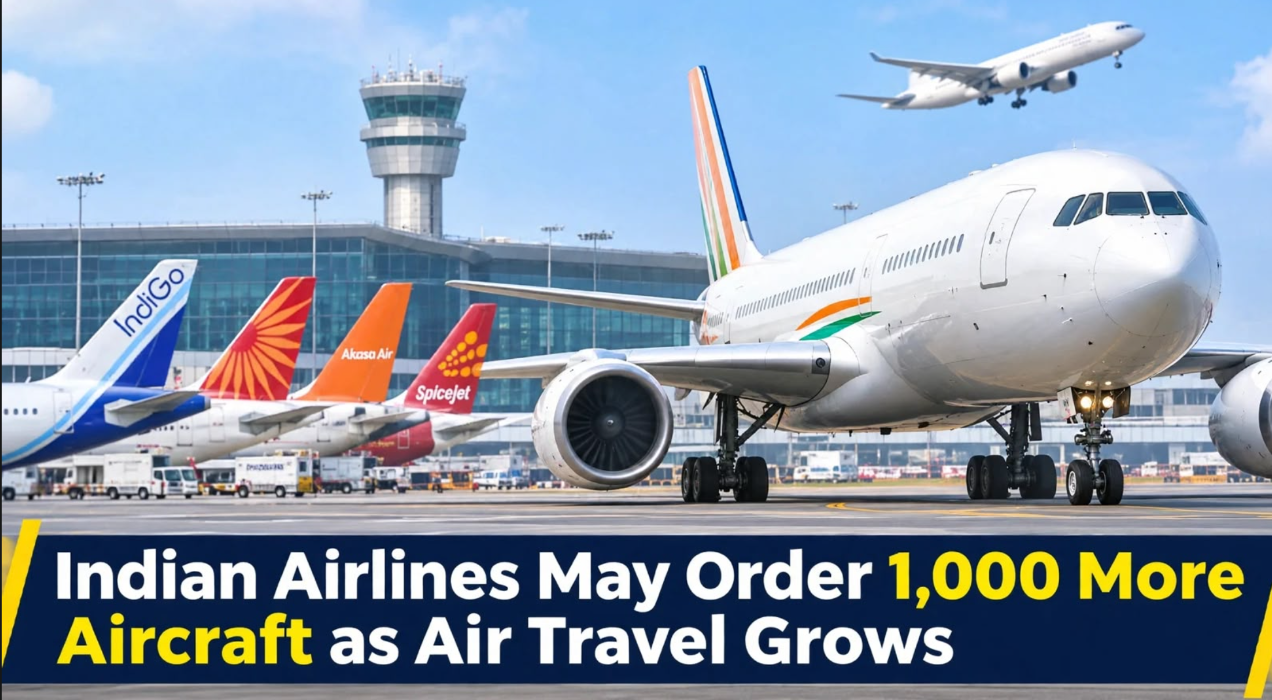
Indian airlines are poised to order another 1,000 aircraft as demand for air travel rises, Commerce and Industry Minister Piyush Goyal has said. Indian carriers have already placed orders for more than 1,200 planes, taking their estimated total requirement beyond 2,000 aircraft amid fleet expansion plans.
Indian Airlines Prepare for Further Fleet Expansion
India’s commercial airlines are preparing to place orders for another 1,000 aircraft as the country’s aviation sector expands amid rising demand for air travel, Union Commerce and Industry Minister Piyush Goyal has said.
Speaking to journalists during his two-day official visit to Egypt, Goyal said Indian carriers, including IndiGo, Air India and Akasa Air, had already placed orders for more than 1,200 aircraft with global manufacturers Boeing and Airbus.
However, the total requirement of Indian airlines is estimated to exceed 2,000 aircraft. The minister also said airlines were asking aircraft manufacturers to accelerate deliveries to meet growing passenger demand.
India-Egypt Air Connectivity Expected to Improve
Goyal said air connectivity between India and Egypt would improve as Indian airlines expanded their fleets, creating opportunities to introduce more flights on the route.
The minister is visiting Egypt to hold discussions on strengthening bilateral trade and investment ties between the two countries.
Greater aircraft availability could support airlines in expanding international operations and strengthening connectivity between India and important overseas markets.
India’s Commercial Aircraft Fleet Set for Strong Growth
India’s aviation sector is projected to record one of the highest aircraft fleet growth rates globally.
According to consultancy Oliver Wyman’s 2026 forecast, India’s commercial aircraft fleet is expected to grow at an annual rate of 7.1% between 2026 and 2036.
However, several large aircraft orders placed by Indian carriers are still awaiting delivery. Figures compiled by the Ministry of Civil Aviation indicate that some aircraft are scheduled to join airline fleets as late as 2034.
Global aircraft manufacturers are facing substantial order backlogs, while shortages of engines and other components have affected production and delivery schedules. These constraints are making timely aircraft availability a challenge for airlines seeking to expand capacity.
Government Focuses on Aircraft Leasing and Financing
Alongside fleet expansion, the government is working to strengthen India’s aircraft leasing and financing ecosystem.
More than 85% of the fleet operated by Indian carriers is leased, according to the Ministry of Civil Aviation. This makes access to affordable financing and a stronger domestic leasing sector important for the aviation industry’s expansion.
The government has been examining measures such as increasing bank credit allocation to aircraft leasing, promoting rupee-denominated financing and introducing regulatory changes to make aircraft leasing easier.
In September, the Ministry of Civil Aviation convened a High-Level Committee meeting to examine bottlenecks in aircraft leasing and financing.
GIFT City to Develop Domestic Aircraft Leasing Hub
A significant part of the government’s strategy is to develop a domestic aircraft leasing and financing ecosystem through GIFT City in Gujarat.
Indian airlines currently source a large share of their aircraft leasing contracts through international financial and leasing hubs, including Ireland and Singapore. This results in substantial foreign exchange outflows through annual lease rentals.
Developing domestic leasing capabilities could provide airlines with more financing options and strengthen India’s position in the global aviation finance sector.
The possibility of another 1,000 aircraft orders reflects the expansion potential of India’s aviation market. However, meeting this demand will depend not only on aircraft manufacturers increasing deliveries but also on improving financing, leasing infrastructure and regulatory support for airlines.