


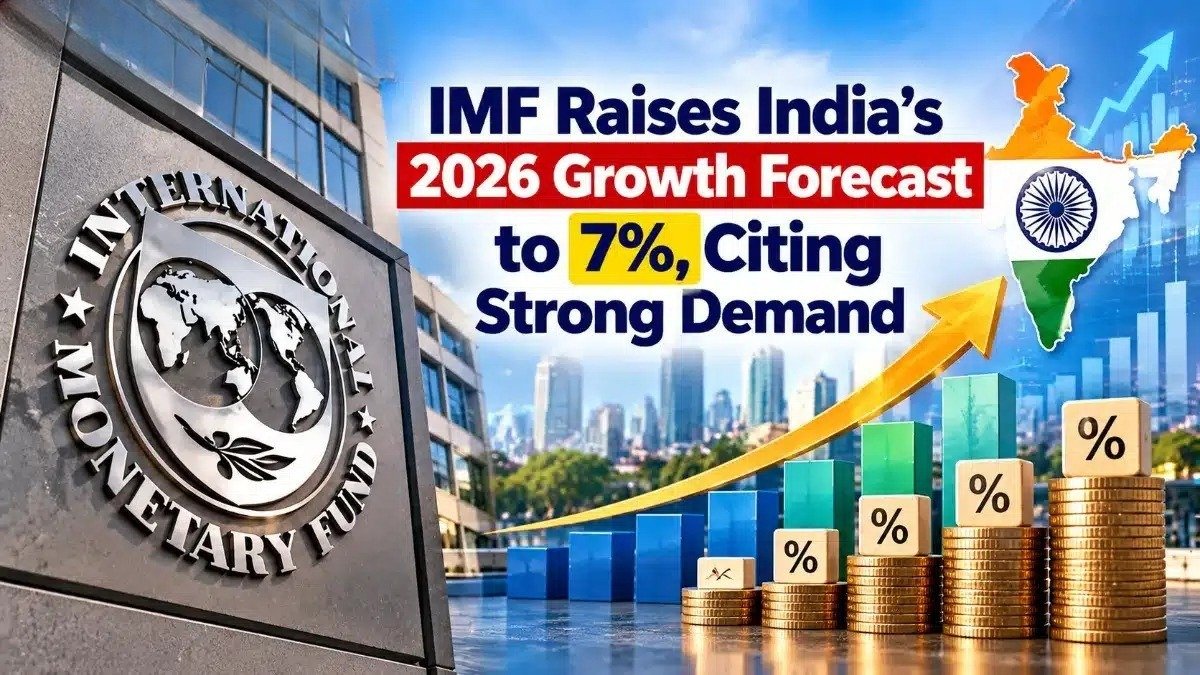
The International Monetary Fund (IMF) has raised India’s economic growth forecast to 7.0% for 2026 and 2027 on a fiscal-year basis, citing resilient domestic demand, robust services activity and stronger-than-expected economic momentum. In its October 2026 World Economic Outlook (WEO), the Fund said India remains among the fastest-growing major economies despite higher oil prices and uncertainty linked to the conflict in the Middle East.
The IMF raised its 2026 growth projection by 0.6 percentage points from its July 2026 forecast and by 0.5 percentage points from its April projection. For 2027, it increased the forecast by 0.3 percentage points from July and 0.5 percentage points from April.
IMF Raises India’s Growth Forecast on Strong Domestic Demand
The IMF attributed the upward revision to stronger-than-expected economic momentum, resilient domestic demand and robust services activity. According to the report’s fiscal-year presentation, India’s economy grew by 7.8% in 2025.
On a calendar-year basis, the Fund projected India’s economy to grow by 7.4% in 2026 and 7.0% in 2027. It also highlighted favourable demographic trends, an expanding domestic market and continued structural reforms as factors supporting the country’s long-term growth potential.
The report identified India as an exception among several emerging and advanced economies facing greater pressure on public finances. It indicated that India would not require the same degree of additional fiscal consolidation to stabilise its debt-to-GDP ratio at the 2025 level.
Inflation and External Risks Remain in Focus
Despite the stronger growth outlook, India faces inflationary and external-sector pressures. The IMF projected consumer price inflation at 5.0% in 2026, up from 2.0% in 2025, before easing to 4.4% in 2027.
The Fund also forecast India’s current account deficit at 1.5% of GDP in 2026 and 1.3% in 2027, compared with 0.7% in 2025. Meanwhile, new trade agreements involving India, including agreements with the European Union and the United Kingdom, could reduce tariff and non-tariff barriers, support economic adjustment and strengthen supply-chain resilience.
Global Growth Outlook Faces Geopolitical Uncertainty
The IMF projected global economic growth of 3.1% in 2026 and 3.4% in 2027. Global headline inflation is expected to reach 4.7% in 2026 before easing to 4.1% in 2027.
China’s growth is forecast to slow to 4.5% in 2026 and 4.0% in 2027. Meanwhile, the United States is projected to expand by 2.3% in both years.
The Fund’s baseline assumes average oil prices of $95.74 per barrel in 2026 and $87.39 in 2027. It warned that an escalation or prolonged stalemate in the Middle East could keep energy and food prices elevated, renew inflationary pressures and weaken global growth.
The IMF’s revised projections highlight India’s economic resilience, supported by domestic consumption, services activity and structural reforms. However, rising inflation, oil-price volatility and geopolitical uncertainty remain key risks to the country’s economic outlook.