

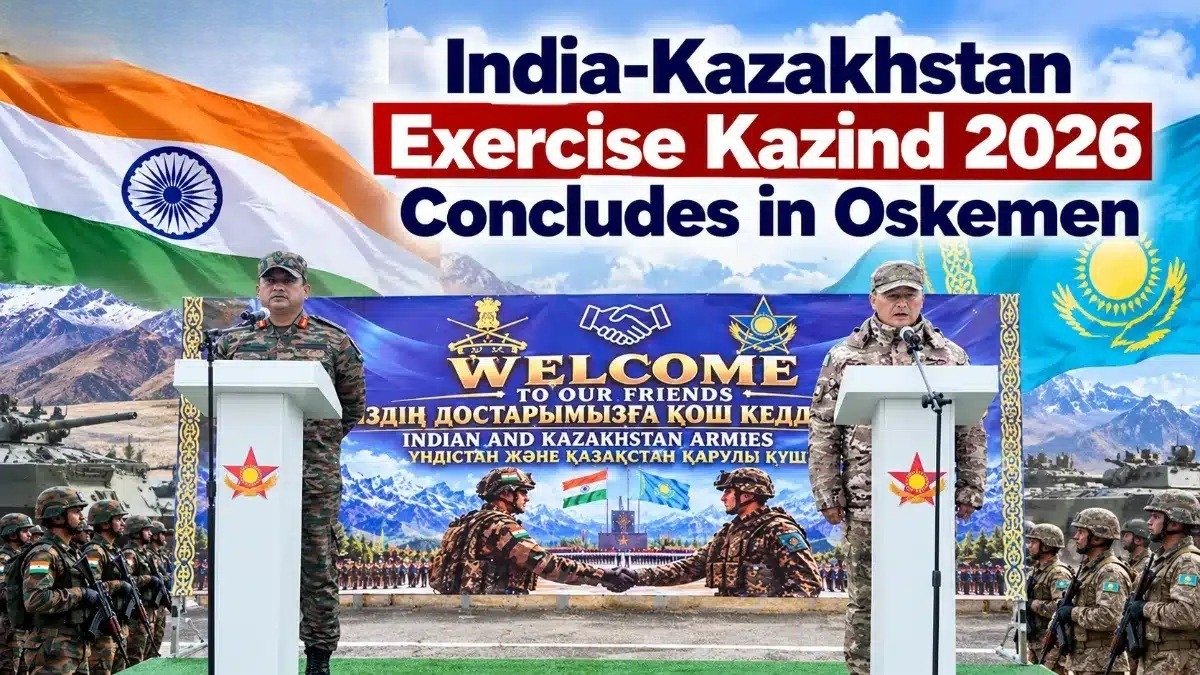
India and Kazakhstan have concluded the ninth edition of their joint military exercise, Exercise Kazind 2026, in Oskemen, Kazakhstan, reaffirming defence cooperation between the two countries. The exercise concluded with a 72-hour validation drill to assess operational readiness, tactical coordination and joint counter-terrorism capabilities.
According to the Indian Army’s Additional Directorate General of Public Information, the training aimed to improve interoperability, strengthen professional camaraderie and enhance the ability of both forces to operate together.
During the exercise, Indian Army personnel and members of the Armed Forces of Kazakhstan conducted tactical navigation drills at the Akhmirovo Training Area, live-firing exercises and combined combat training. These activities focused on sharpening battlefield skills, improving coordination and strengthening operational preparedness. The final validation exercise assessed the forces’ ability to coordinate their actions in demanding operational scenarios.
Exercise Kazind 2026 Strengthens India-Kazakhstan Defence Ties
The opening ceremony of Exercise Kazind 2026 took place in Oskemen on September 29 and was presided over by Major General Zhenis Maralov, Chief of Regional Command East of the Armed Forces of Kazakhstan.
The Indian contingent comprised 60 personnel, primarily from a battalion of the Garhwal Rifles, along with personnel from other arms and services and the Indian Air Force. Kazakhstan also deployed a contingent of comparable strength, consisting mainly of personnel from its Land Forces, according to the Ministry of Defence.
The exercise focused on enhancing the joint capabilities of both armed forces to conduct counter-terrorism operations in a sub-conventional environment under a United Nations mandate. Through coordinated tactical drills and field training, participating troops worked to improve operational compatibility and mutual understanding.
The conclusion of Exercise Kazind 2026 marks another engagement in India and Kazakhstan’s military cooperation, strengthening professional ties and the operational interoperability of their armed forces.