

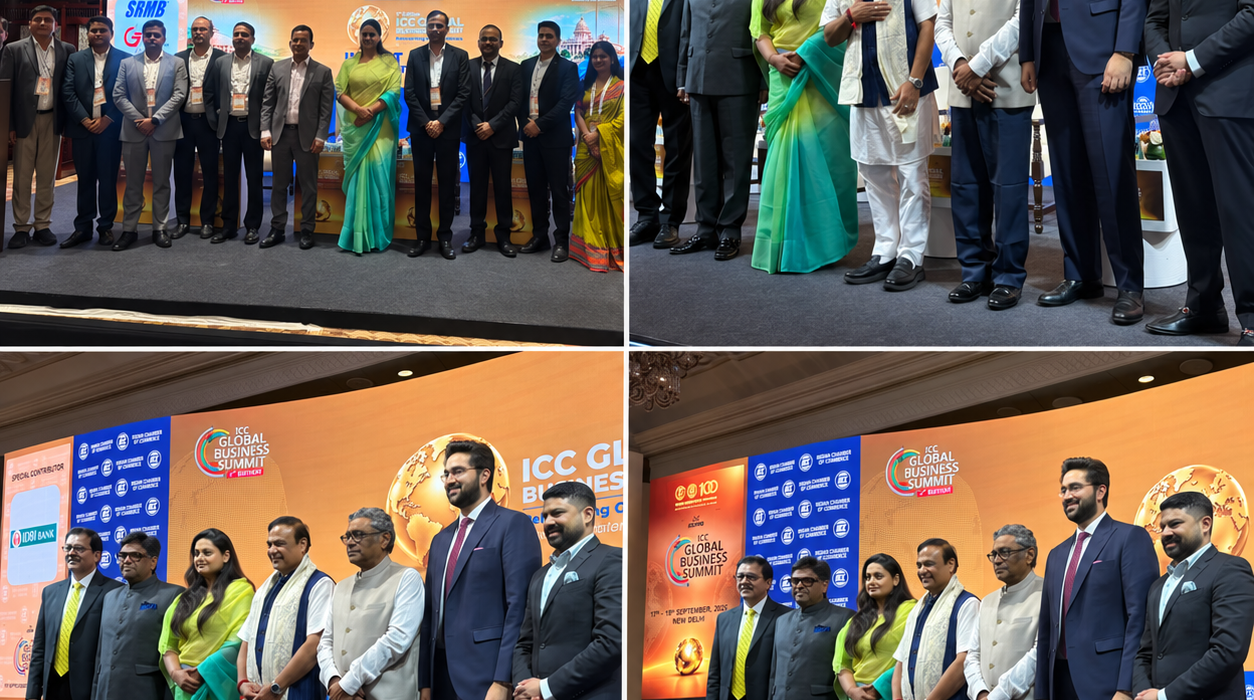
“Bengal Needs To Catch Up To Bihar And Odisha,” Admits State’s Own Finance Minister At ICC Global Business Summit 2026. The inaugural session of the ICC Global Business Summit 2026, held under the theme “Reinventing Global Business: Growth, Risk & Resilience,” opened at Taj Palace, New Delhi, on September 18, bringing together ministers from Assam, West Bengal and Bihar for a session on India’s Eastern and Northeastern growth corridor.
Assam Chief Minister Dr Himanta Biswa Sarma opened the ministerial remarks with a data-heavy account of his state’s growth, framing it within what he called the Purvodaya push, the central government’s plan to make the East and Northeast the next engine of national growth.
He said Assam’s nominal GSDP is estimated at Rs 7.45 lakh crore for 2025-26, with real growth above 10 per cent, projected to rise to Rs 8.71 lakh crore in 2026-27. He cited a Reserve Bank of India report recognising Assam as the fastest-growing economy in the country, with industry now accounting for 35.54 per cent of the state’s current price GSVA.
On execution, Sarma pointed to Assam’s Advantage Assam 2.0 summit, which drew investment commitments of Rs 5.18 lakh crore, of which Rs 3.5 lakh crore has already been converted into on-ground projects within a year. Since May 2021, more than 3,700 new factories have registered in the state, representing close to 1.11 lakh factory jobs, and the single window clearance system has processed over 2.5 million approvals.
He highlighted Tata Electronics’ Rs 27,000 crore semiconductor assembly and test facility, expected to be commissioned in December this year with capacity to produce up to 48 million chips a day and generate more than 27,000 direct and indirect jobs, alongside PepsiCo’s recently commissioned food manufacturing facility in the state.
On infrastructure, he cited seven operational airports, a new Guwahati terminal designed for roughly 30 million passengers annually, and a multi-modal logistics push spanning the Jogighopa logistics park and the Brahmaputra navigable economic corridor. He also outlined plans for 6,000 megawatts of renewable energy capacity by 2030 and cited an export consignment of Assam-grown matcha to Japan.
Closing his remarks, Sarma made an unusual offer to investors: round-the-clock access to the state’s top bureaucracy. “A chief minister or a chief secretary, both, or my team, will respond to you even if it is midnight, 2 am, 4 am, anytime, within 5 minutes,” he said.
West Bengal Finance Minister Dr Swapan Dasgupta followed with a markedly more candid account of his state’s recent history. “For 50 years, Bengal somehow disappeared from the development and economic map of India,” he told delegates, tracing the decline to capital flight in the 1960s, subsequent left-wing political turbulence, and successive governments that prioritised welfare spending over industrial growth.
He did not shy away from ranking his own state behind its neighbours. “Bengal needs to catch up to Bihar. Bengal needs to catch up to Odisha. Bengal needs to catch up to Assam,” Dasgupta said, adding that the admission “will not be very popular when it is translated back home.”
He framed Bengal’s recovery around its location as a gateway to Assam and the Northeast, pressed for a coordinated Eastern India approach on tea, power and education, and pointed to plans for an education city and a medical tourism ecosystem. Policy predictability, he said, was what investors valued most.
Bihar Industry Minister Smt. Shreyasi Singh, a former national shooting champion, rounded off the ministerial remarks by invoking her own journey. “When people asked me, when I was a girl, can she pick up a shotgun and shoot, will she be able to represent or even win for India, I broke all those rules, I broke all those questions and I answered them with the medals and the laurels that I have today,” she said.
Turning to Bihar’s investment record, Singh said the state had drawn direct on-ground investment of roughly Rs 50,000 crore in 2023, rising to Rs 1.81 lakh crore in 2024, and was on track to cross Rs 5 lakh crore in 2026.
She cited a manufacturer from Maharashtra who relocated his unit to Bihar in 55 days, expanding from 150 machines to more than 7,500, and pointed to Bihar-based exporters including Pearl Global, present in over nine countries, alongside makhana and sattu now reaching overseas markets through the state’s aviation links.
She closed on a note of what she called “healthy competition” among the states sharing the stage, in keeping with the spirit of unity in diversity behind the Prime Minister’s Viksit Bharat 2047 vision.
ICC President Brij Bhushan Agarwal, CMD of Shyam Metalics & Energy Ltd, said the gathering brought together leadership from states across East and North India, each with its own distinctive economic strengths, a significance he tied to ICC’s own roots in the region as a chamber headquartered in Kolkata with a regional office in Guwahati.
“The presence of these great leaders is a reflection of the growing importance of industry-government partnership in driving the next phase of economic growth,” he said.
The session also featured the exchange of three Memoranda of Understanding, alongside the presentation of the ICC Global Business Awards. The first was signed between ICC and FINEST, the Italian body that supports Italian companies expanding globally, with FINEST president Luca Di Benedetto joining on stage; Agarwal said the partnership would help companies at the summit identify Italian partners eyeing the Indian market. The second MOU was signed with the Harmonic Innovation Group, and the third with the Institute of Cost Accountants of India (ICMAI), with representatives from both organisations invited on stage for the exchange.
The ICC Global Business Summit 2026 continues at Taj Palace, New Delhi, through September 19.