


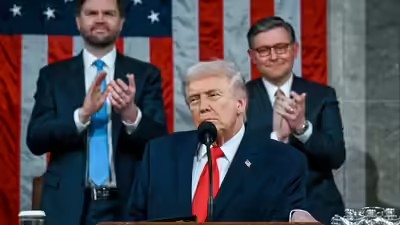
President Donald Trump boldly claimed that tariff revenue could eventually replace income taxes in the United States, defending his trade policies during his 2026 State of the Union address on Tuesday. Speaking on February 25, 2026, Trump asserted that “Congressional action will not be necessary” for this transition, explaining that “as time goes by, I believe the tariffs, paid for by foreign countries, will, like in the past, substantially replace the modern day system of income tax.”
The President’s address came just days after the US Supreme Court delivered a significant blow to his trade agenda by striking down several of his sweeping global tariffs. Last week’s 6–3 ruling found that Trump had exceeded his authority in imposing those duties. Trump described the decision as a “very unfortunate ruling” during his address.
Despite the legal setback, Trump expressed confidence that America’s trading partners would maintain their existing arrangements. “The good news is that almost all countries and corporations want to keep the deal that they already made,” he stated, adding that these nations recognize any new deal “could be far worse for them.”
In response to the court’s decision, Trump swiftly imposed new 10 percent duties under a different legal authority, with the measure taking effect Tuesday. He has pledged to raise this rate to 15 percent, noting these temporary tariffs will last 150 days unless extended by Congress.
Trump credited his tariff policies with driving America’s economic resurgence, pointing to major stock market milestones. He declared that tariffs were a primary reason for the country’s stunning economic turnaround, claiming to have taken in hundreds of billions of dollars while making beneficial deals for national security.
The President further argued that countries “ripping us off for decades are now paying us hundreds of billions of dollars,” asserting these nations are happy with the arrangements. He contrasted his record against expert predictions, noting that 22 Nobel Prize winners had incorrectly forecast the outcomes of his policies.
However, a New York Federal Reserve paper released this month presents a contradictory picture, finding that nearly 90 percent of the tariffs’ economic burden has actually fallen on American firms and consumers rather than foreign countries, challenging Trump’s narrative of who ultimately pays for these trade barriers.