

When Sanae Takaichi took office on 21 October 2025 as Japan’s first woman Prime Minister, the symbolism was powerful. But beyond the historic optics lies a more consequential political moment: Japan is entering a period of transition, even uncertainty, while its foreign policy must stay steady in an increasingly contested Indo-Pacific.
For India, this change of guard comes at a time when New Delhi and Tokyo have already laid an expansive roadmap for the next decade. Prime Minister Narendra Modi’s visit to Japan in August 2025—hosted by then Prime Minister Shigeru Ishiba—produced the most comprehensive blueprint yet for the Special Strategic and Global Partnership.
Takaichi inherits not only this framework but also the burden of continuity. Her early diplomatic instincts suggest she understands that Japan’s domestic churn must not distract from its wider strategic commitments. Among those, none is more consequential—or more historically resilient—than the relationship with India.
Civilizational Depth Meets 21st Century Imperatives
India–Japan ties are often praised for their absence of friction. That is true, but also incomplete. It is not the lack of conflict alone that makes the relationship exceptional—it is the depth of affinity going back 1,400 years.
From the Indian monk Bodhisena’s consecration of the Todaiji Buddha in 752 AD to the intellectual exchanges of Vivekananda, Tagore, and JRD Tata, India’s presence in Japan’s cultural imagination has been unusually intimate. Judge Radha Binod Pal’s famous dissent at the post-war Tokyo Trials remains, for many Japanese, a lasting emblem of Indian fairness at a time of global hostility.
Unlike many bilateral relationships shaped by colonial legacies or territorial disputes, India and Japan have built theirs on trust, respect, and shared democratic convictions. This cultural harmony now underpins a strategic relationship increasingly defined by economic resilience, technological ambition, and security coordination.
From Ishiba to Takaichi: A Joint Vision in Transition
The Modi–Ishiba summit of August 2025 marked a watershed. The two leaders unveiled a Joint Vision for the Next Decade, spanning eight broad pillars—from economic security and technological innovation to mobility, environment, and people-to-people ties.
They elevated defence cooperation, launched a new Economic Security Initiative centered on critical technologies and supply chain resilience, and finalised an Action Plan for Human Resource Exchange targeting 500,000 bilateral exchanges in five years, including pathways for 50,000 skilled Indian workers in Japan.
This is the inheritance Takaichi steps into, and her early moves indicate a desire to preserve momentum. Her first call with Prime Minister Modi underscored continuity: commitment to a Free and Open Indo-Pacific, affirmation of Quad centrality, and a pledge to advance the India-Japan partnership as a stabilising force in Asia.
But continuity is not enough. The Indo-Pacific’s political landscape is shifting rapidly. China’s maritime posturing, North Korea’s nuclear brinkmanship, and the resurgence of geopolitical bloc politics demand deeper India–Japan coordination. The Takaichi era offers a chance not only to sustain the Ishiba blueprint but to operationalise it.
Economic Security as the New Strategic Anchor
One of the most underestimated dimensions of India–Japan ties is the centrality of economic security. For Japan, a nation heavily dependent on external supply chains and vulnerable to coercive pressures, diversification is no longer a choice—it is a strategic necessity. India, with its scale, talent pool, manufacturing potential, and political stability, is uniquely placed to become a core pillar of Japan’s supply chain strategy.
The newly created India–Japan Economic Security Initiative aims precisely at this. It encourages collaboration in semiconductors, critical minerals, telecom and cybersecurity, pharmaceuticals, clean energy and battery technologies
These are not token areas—they are the backbone of global strategic competition in the 2020s. Joint investments in semiconductor fabrication, India-based data centres supported by Japanese firms, and co-development of resilient mineral supply chains across Africa and the Indo-Pacific can set the stage for a new economic architecture.
Japan’s earlier commitments—such as public and private investments worth trillions of yen, the Delhi-Mumbai Industrial Corridor, and the Shinkansen-powered High-Speed Rail—were transformational. But the next decade must focus on technological co-creation rather than just infrastructure financing.
Defence: From Symbolism to Substantive Capability
Defence cooperation between India and Japan has grown steadily, but the Takaichi era must take it into deeper waters. Japan’s security environment is more precarious than it has been in decades—Chinese incursions in the East China Sea, ballistic threats from North Korea, and uncertainties around US extended deterrence. India faces its own multidimensional pressures, from the Himalayas to the Indian Ocean.
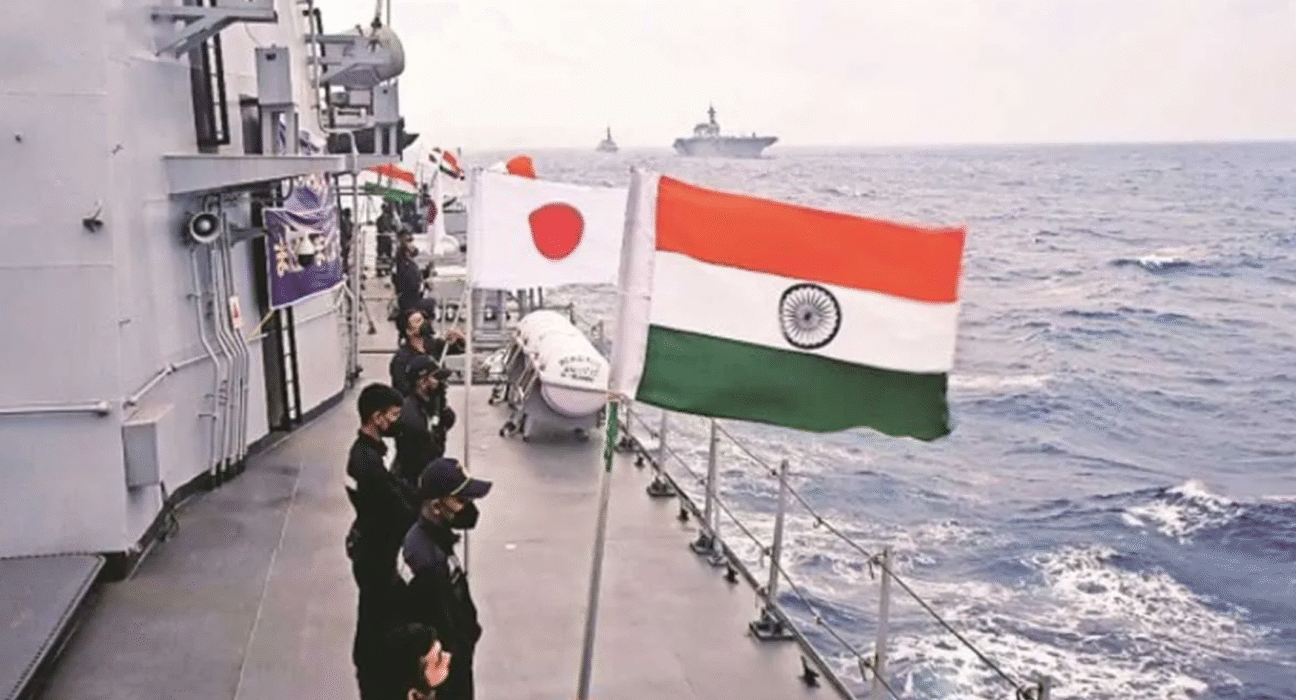
The 2025 Joint Declaration on Security Cooperation offers a path to elevate defence ties beyond exercises. Maritime collaboration through JIMEX, participation in MALABAR, and Japan’s involvement in Milan and Tarang Shakti show growing interoperability. But the next phase requires tangible outcomes: co-production of UAVs, surveillance assets, undersea domain awareness technologies, and joint R&D in cybersecurity and space situational awareness.
Japan’s recalibrated defence posture under Takaichi—more assertive, more self-reliant, and more open to partnerships—aligns naturally with India’s doctrine of multi-alignment and strategic autonomy.
The Human Capital Compact
Perhaps the most future-shaping element of the India–Japan partnership is not defence or technology, but people. Japan’s ageing population and shrinking workforce contrast sharply with India’s youthful demographic surge. The Action Plan for Human Resource Exchange is potentially revolutionary: language-trained Indian professionals in sectors like caregiving, manufacturing, digital services, and engineering can revitalise Japan’s economy.
India’s Japan-focused skilling ecosystem—Japan Industrial Townships, the Kaizen-based manufacturing training model, and Japanese language programmes—creates a talent pipeline unmatched by any other partner. This is not just labour mobility; it is socio-economic integration.
Subnational Diplomacy: The Next Frontier
While national leaders set the tone, much of the bilateral dynamism now lies in state–prefecture cooperation. Gujarat-Shizuoka, Tamil Nadu-Ehime, Uttar Pradesh-Yamanashi, and Andhra Pradesh-Toyama are emerging as innovation hubs that drive industrial collaboration, tourism, and cultural exchange. As Japan decentralises more economic authority and India’s states compete globally for investment, this layer of diplomacy could become the partnership’s most agile engine.
Shaping the Indo-Pacific Order
In a region increasingly defined by rivalries, India and Japan share a rare clarity: that the Indo-Pacific must remain open, rules-based, and resistant to unilateralism. Their coordination in the Quad, their shared positions on the East and South China Seas, and their collaboration in Africa—most notably through the India-Japan Cooperation Initiative for Sustainable Economic Development—signal their willingness to shape regional order, not merely respond to it.
Both nations also remain strong advocates of UN reform, especially the expansion of the Security Council to reflect contemporary geopolitical realities. With a reform-resistant international system and a shifting balance of power, their alignment on global governance becomes even more critical.
A Partnership Poised for a New Era
Sanae Takaichi may not enjoy the political longevity of her predecessors, but foreign policy—especially relations with India—could well become her most stable legacy. If she anchors her leadership in Japan’s long-standing democratic commitments and strategic constancy, she can not only sustain the Ishiba–Modi momentum but also carve her own chapter in Indo-Pacific diplomacy.
For India, Japan remains a dependable partner—economically, technologically, and strategically. The two democracies have the credibility, capacity, and convergence needed to shape an Indo-Pacific that is secure, prosperous, and free from coercive power politics.
The India–Japan story is not about managing crises. It is about building the future. And in the Takaichi era, that future may be closer than ever.
The column has been authored by Pravin Kumar Singh, Senior Project Associate, World Intellectual Foundation.
Source – sarkaritel.com
For more news visit our site: Click here