

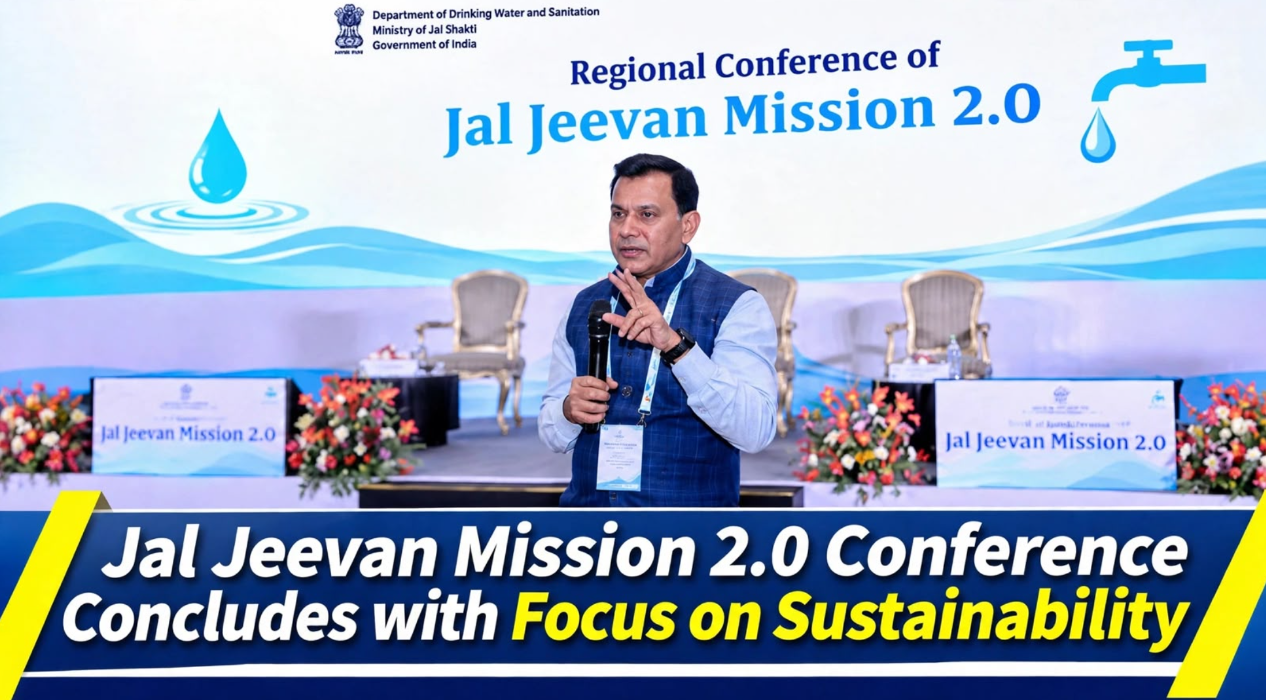
The second regional conference on Jal Jeevan Mission (JJM) 2.0 concluded in Agra, Uttar Pradesh, on November 27, 2026, with seven northern States and Union Territories reaffirming their commitment to sustainable rural drinking water services.
Organised by the Department of Drinking Water and Sanitation (DDWS), Ministry of Jal Shakti, the two-day conference brought together representatives from participating States and UTs to discuss strategies for accelerating Mission implementation, strengthening sustainability and ensuring the long-term functionality of rural drinking water supply systems.
The concluding day featured visits to five rural water supply schemes across Etah, Hathras, Mainpuri and Aligarh districts, along with Jal Arpan Diwas celebrations in five villages. Discussions focused on community ownership, Gram Panchayat-led water governance, financial sustainability and effective operation and maintenance of rural water infrastructure.
Ashok K.K. Meena Calls for Gram Panchayat-Led Water Governance
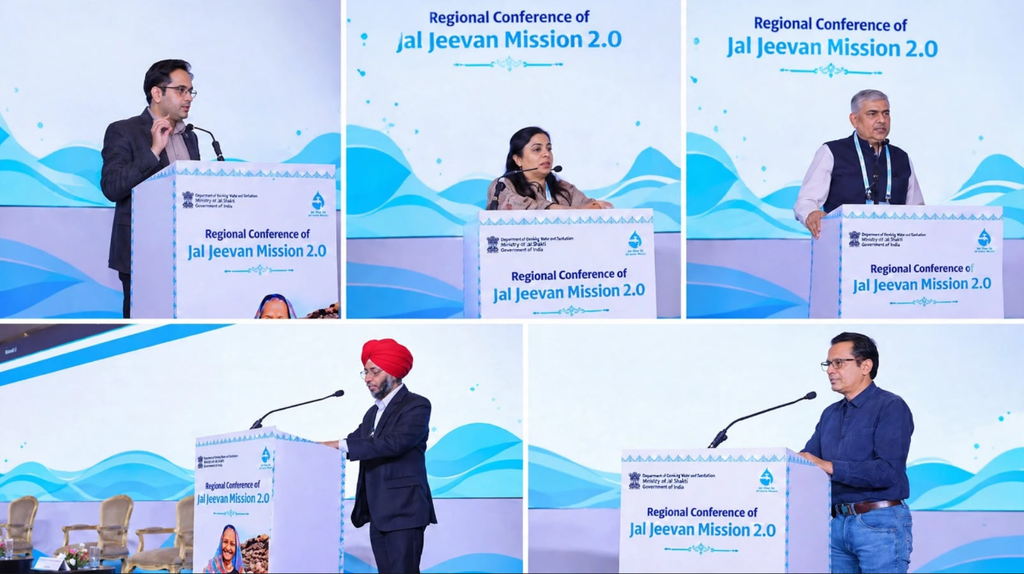
During the valedictory session, DDWS Secretary Ashok K.K. Meena said the conference had provided a platform for States and UTs to develop a common understanding of the reforms envisaged under JJM 2.0 and exchange implementation experiences.
Referring to the field visits, he highlighted practices in Uttar Pradesh, including the use of solar energy for rural water supply schemes and command-and-control systems for monitoring and operating water infrastructure. He encouraged participating States to examine these practices for wider adoption.
Meena emphasised that rural drinking water service delivery is fundamentally a local responsibility. He called for stronger ownership of water supply assets by Gram Panchayats and communities, describing Jal Arpan as an important step towards transferring responsibility for drinking water infrastructure to local communities.
He also stressed the need to strengthen the financial, technical and institutional capacities of Gram Panchayats to ensure uninterrupted services. Infrastructure creation, he said, must be supported by effective management, regular water quality surveillance and active community participation.
Convergence among Panchayati Raj, Rural Development, Skill Development and Drinking Water departments was identified as essential for improving operation and maintenance, developing local capacities and ensuring source sustainability through initiatives such as Jal Sanchay Jan Bhagidari.
Digital Mapping and Financial Support for Rural Water Systems
Additional Secretary and Mission Director, National Jal Jeevan Mission, Kamal Kishore Soan, called for digital mapping of drinking water supply infrastructure and greater use of existing institutional platforms for capacity building.
He highlighted a joint initiative by DDWS and the Ministry of Panchayati Raj to align training programmes under Swachh Bharat Mission-Gramin (SBM-G) with the capacity-building framework of the Rashtriya Gram Swaraj Abhiyan (RGSA). Integrating water and sanitation training into existing Panchayati Raj programmes would strengthen the capabilities of Sarpanches, Panchayat Secretaries and grassroots functionaries, he said.
Joint Secretary, DDWS, D. Senthil Pandiyan, called for a whole-of-government approach to sustainable rural drinking water services, with stronger coordination among departments dealing with drinking water, Panchayati Raj, Rural Development, Tribal Affairs and Skill Development.
He also highlighted Gram Panchayat ownership of water infrastructure, capacity building of Village Water and Sanitation Committees (VWSCs), Sujalam Shakti, digital monitoring through the Sujalam framework, water quality surveillance and institutional mechanisms for long-term operation and maintenance.
Director, Ministry of Panchayati Raj, Vijay Kumar, highlighted opportunities under the 16th Finance Commission framework to strengthen rural drinking water services. He stressed the need to map water supply infrastructure on the e-GramSwaraj portal, incorporate drinking water priorities into Gram Panchayat Development Plans (GPDPs) and utilise Finance Commission grants for the operation and maintenance of rural water supply assets.
Officials Visit Five Water Supply Schemes on Jal Arpan Diwas
As part of the concluding day’s programme, five teams comprising senior Central Government officials, representatives of participating States and UTs, partner Ministries and technical institutions visited rural drinking water schemes and participated in Jal Arpan ceremonies.
The five schemes covered were Badhera (Bhadaira) in Etah district, Nagla Babu and Sultanpur in Hathras district, Simrau in Mainpuri district, and Shahpur Qutub in Aligarh district.
The visits were led by senior officials, including DDWS Secretary Ashok K.K. Meena, NJJM Additional Secretary and Mission Director Kamal Kishore Soan, and Joint Secretary D. Senthil Pandiyan, along with other NJJM officials and representatives of SPM NIWAS and participating States and UTs.
The teams observed water treatment and distribution systems, interacted with Panchayati Raj Institution representatives and VWSC members, and reviewed community participation in operation and maintenance. They also observed trained women conducting water quality tests using Field Testing Kits (FTKs), highlighting the role of local communities in monitoring drinking water services.
During the village visits, Ashok K.K. Meena and Kamal Kishore Soan drank water directly from household taps to reinforce confidence in the quality and safety of the supplied water. They encouraged officials to adopt similar practices during field visits to build public trust.
Meena emphasised that Jal Arpan should be communicated as a step towards shared responsibility for sustainable water service delivery, rather than merely the handover of infrastructure. He also stressed the need for implementing departments to provide continued technical support to Gram Panchayats, particularly in cases involving major repairs and infrastructure breakdowns.
Gram Panchayats, VWSC members, Self-Help Groups, schoolchildren and community representatives participated in the ceremonies, which focused on water conservation, responsible water use and community ownership of drinking water assets.
States Reaffirm Commitment to Sustainable Water Services
Over the two days, the conference addressed implementation reforms, source sustainability, operation and maintenance, local skill development, inter-ministerial convergence, financial sustainability and community ownership of rural drinking water infrastructure.
Participating States and UTs reaffirmed their commitment to accelerating JJM 2.0 implementation and strengthening sustainable, community-owned and service-oriented rural drinking water systems. The deliberations and field visits are expected to support inter-state learning, improve programme implementation and contribute to long-term water security in rural India.
The conference highlighted the shift under JJM 2.0 from expanding water supply infrastructure to ensuring its long-term functionality. Strengthening Gram Panchayats, developing local technical capacity, ensuring financial sustainability and promoting community ownership will remain central to reliable rural drinking water services.