

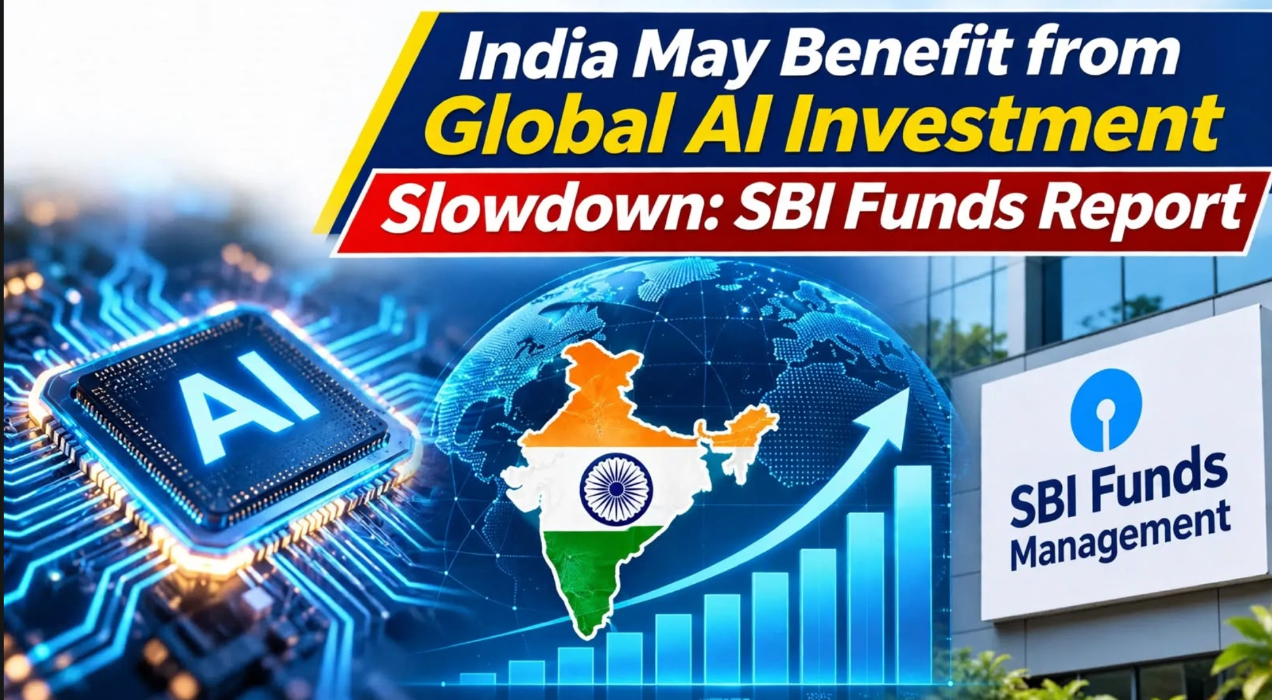
India could benefit if concerns over the sustainability of global artificial intelligence (AI) investments trigger a shift in international capital flows, according to a report by SBI Funds. The report highlights India’s relative market resilience, stable economic indicators and 23% growth in merchandise exports during Q3 2026.
The report estimates that AI-related capital expenditure will average around 3.6% of US GDP between 2025 and 2032. This would be significantly higher than the 1.1% recorded during the dotcom investment cycle in 2000 and the 2.2% witnessed during the 19th-century railroad boom.
SBI Funds Flags Risks from Global AI Investment Slowdown
The unprecedented expansion in AI investments has supported economic growth, particularly in the United States. However, substantial borrowing by hyperscalers and technology companies has also put pressure on long-term bond yields.
The report cautioned that if AI revenues fail to meet expectations, maintaining current levels of capital expenditure at prevailing financing costs could become challenging.
According to SBI Funds, any weakening of the AI investment trend could have wider implications for related industries, US equities, economic growth and the allocation of funds across asset classes. Since the AI trade has attracted substantial capital from other investment avenues, a slowdown could encourage investors to redirect funds towards alternative markets and assets.
Indian Markets Show Relative Resilience
Indian equity markets demonstrated relative resilience in October despite a sharp sell-off across emerging markets. The Nifty gained around 1.9%, while the Sensex advanced approximately 2.7% during the month, making India one of the few major markets to record gains.
In comparison, the MSCI Emerging Markets index declined 6.6%. AI-linked markets such as South Korea and Taiwan, which had led gains earlier in the year, fell 16.2% and 5.7%, respectively.
The report also noted that Indian economic indicators have remained relatively stable despite challenges arising from elevated energy prices and their potential impact on inflation and government finances.
SBI Funds Notes 23% Growth in Merchandise Exports
India’s merchandise exports increased by approximately 23% in Q3 2026, supported by a recovery in global trade and an improved tariff position relative to competing economies.
The SBI Funds report suggests that a potential moderation in global AI investment could influence the direction of international capital flows. With Indian markets showing relative resilience and exports recording strong growth, India could benefit if investors diversify away from AI-heavy markets. However, the extent of any benefit will depend on global investment trends and domestic economic conditions.