


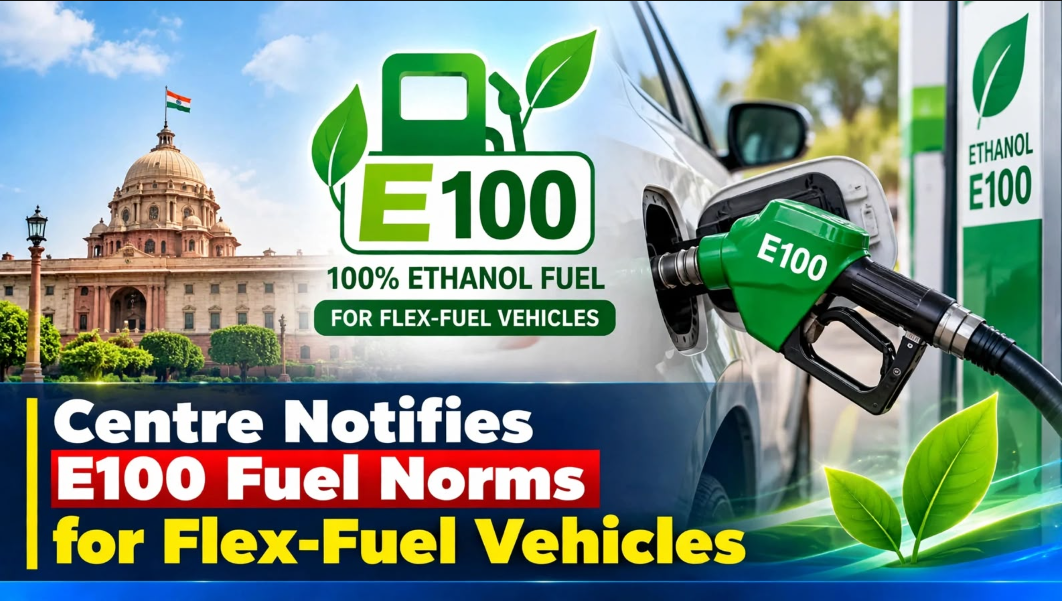
The Centre has amended the Central Motor Vehicles Rules, 1989, to introduce provisions for E100 fuel, or 100% ethanol, in flex-fuel vehicles. The Ministry of Road Transport and Highways has updated relevant fuel references, emission standards and vehicle-testing requirements.
Under the amendments, references to E85 fuel in specified provisions have been expanded to include E85 or E100. The government has clarified that these fuels can be used only in flex-fuel vehicles designed by original equipment manufacturers (OEMs).
E100 Fuel Amendments Update Vehicle Standards
The changes also revise certain vehicle and fuel classifications, including an increase in the gross vehicle weight threshold in one emission table from 3,000 kg to 3,500 kg.
Other amendments cover hydrogen-compressed natural gas (HCNG), petrol containing up to 20% ethanol (E20), biodiesel standards and technical corrections to emission-testing tables. These updates form part of the regulatory framework for vehicle emissions and alternative fuels.
Ethanol Demand May Rise Under E25 Blending
Union Road Transport and Highways Minister Nitin Gadkari has previously highlighted the potential cost benefits of ethanol-powered vehicles, suggesting that fuel costs could be equivalent to around ₹25 per litre.
Separately, a Brickwork Ratings analysis projected that ethanol demand could reach 17.9 billion litres by FY31 under an E25 blending scenario. The report estimated that existing installed distillation capacity of 18.25 billion litres could meet demand under its base and bear scenarios, with utilisation approaching 98% in the base case.
Under an E20 blending scenario, the report estimated demand at 14.3 billion litres, implying capacity utilisation of around 78%.
The amendments establish a regulatory basis for E100 fuel in compatible flex-fuel vehicles. Their practical impact will depend on the availability of OEM-designed vehicles, fuel supply infrastructure and the pace of ethanol-blending expansion across India.