

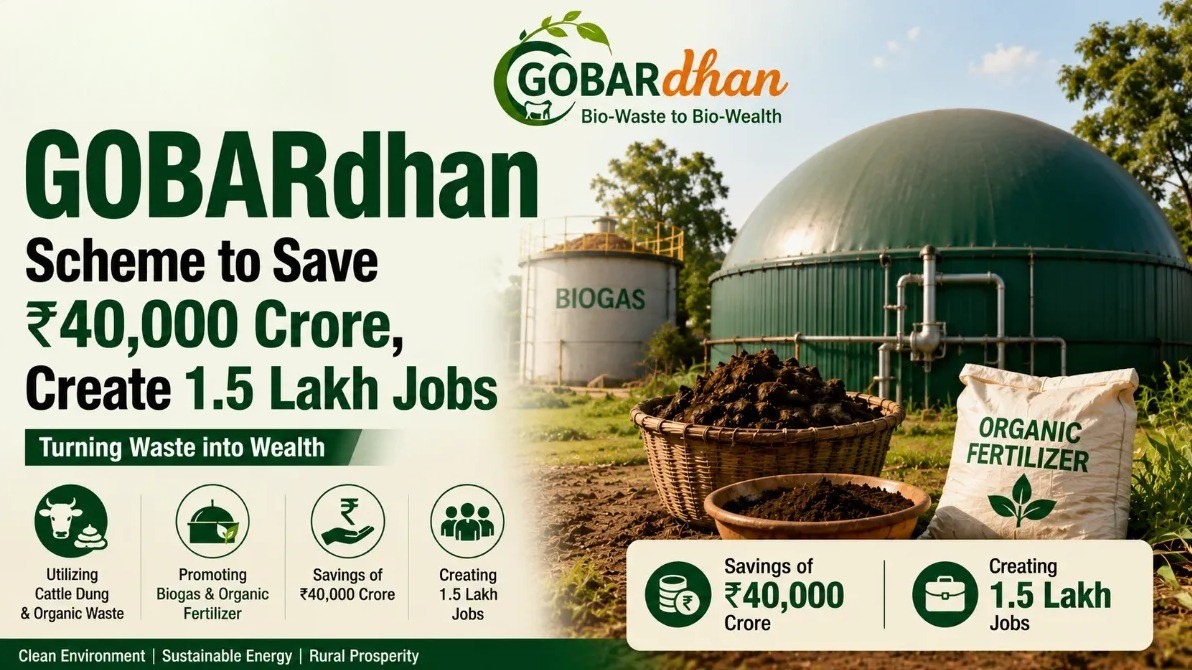
The GOBARdhan National Circular Bioenergy Scheme is expected to strengthen India’s bioenergy sector while reducing dependence on imported fossil fuels.
According to the government, the scheme could save more than ₹40,000 crore in foreign exchange. It is also expected to create around 1.5 lakh jobs and add more than ₹75,000 crore to India’s GDP.
The Union Cabinet approved the scheme with a total outlay of ₹23,731 crore. It will be implemented from FY27 to FY36.
Focus on compressed biogas
A key objective of the GOBARdhan Scheme is to increase domestic compressed biogas (CBG) production nearly tenfold over the next decade.
The government expects domestically produced CBG to replace around 10 million metric tonnes of fossil fuels. This could help reduce India’s dependence on imported natural gas and improve energy security.
The scheme will also support better management of organic waste. The government estimates that diverting waste from landfills could reduce more than 40 million tonnes of carbon dioxide emissions.
The process is also expected to generate nearly 250 million metric tonnes of organic fertilizer. This could support farmers while promoting more sustainable waste management.
Incentives for CBG projects
The scheme includes several measures to encourage investment in CBG production.
These include guaranteed CBG offtake and a government administered price of ₹2,110 per MMBTU. Eligible projects can also receive capital assistance of up to ₹2 crore per tonne per day (TPD) of installed CBG capacity.
MSME based projects will be eligible for credit guarantees covering up to 85%. The scheme also supports pipeline connectivity and improved market access for CBG producers.
According to the government, 1,908 CBG and Bio CNG plants have been registered through the GOBARdhan Unified Registration Portal. Of these, 217 plants are operational and 339 are under construction.
Boost to rural employment
The scheme aims to create a local circular economy around each CBG plant.
CBG facilities can use agricultural residues, cattle dung and other organic waste as feedstock. These materials can be converted into renewable gas and organic manure.
This process is expected to create jobs in waste collection, transportation, plant operations, logistics and fertilizer production.
The government also expects the scheme to support rural incomes and reduce greenhouse gas emissions.
Supporting India’s clean energy transition
The GOBARdhan Scheme is part of India’s wider push towards a low carbon economy and greater energy self reliance.
By expanding domestic CBG production, the programme aims to reduce fossil fuel imports while creating new opportunities in renewable energy, waste management and rural employment.
The government expects the scheme to strengthen India’s bioenergy ecosystem, support the circular economy and contribute to the broader Atmanirbhar Bharat agenda.