


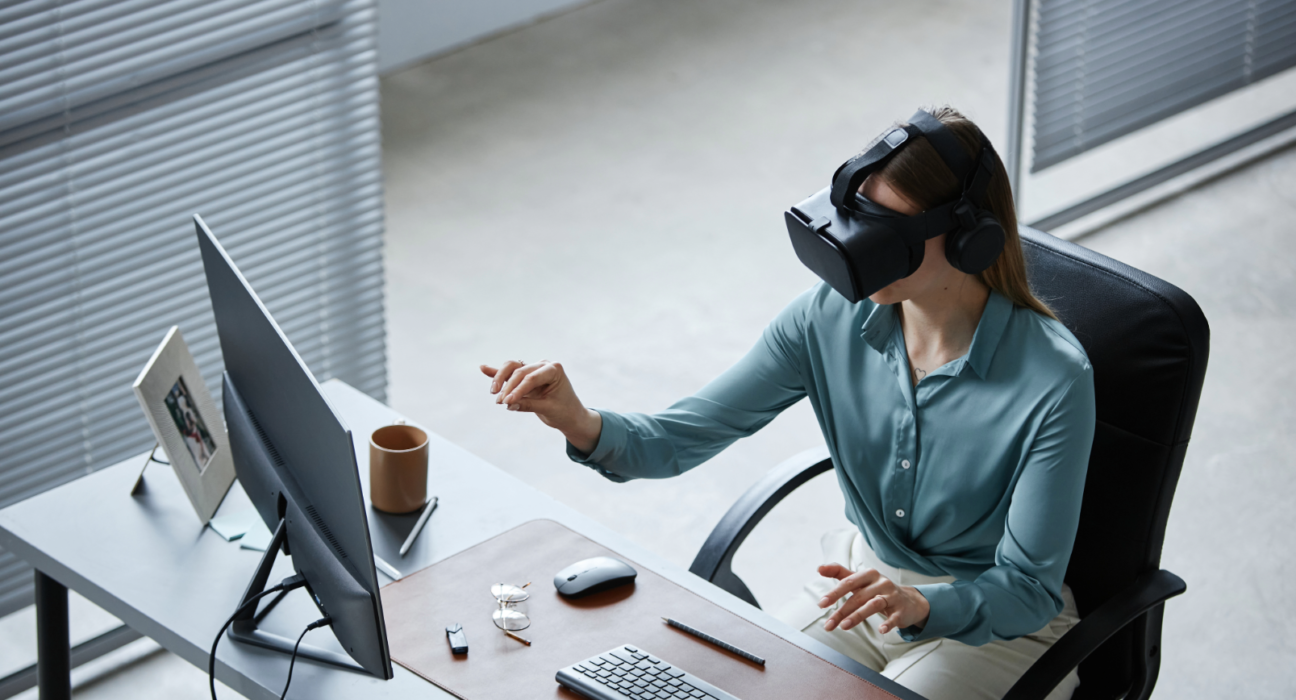
Corporate training is often reliant on meeting sessions, manuals, and on-the-job supervision.
But these methods do include hidden costs like travel expenses, venue rents, lower or no
productivity, and safety risks as well. Today, forward-thinking about the future, companies
are shifting to virtual reality training, replacing old techniques with cost-effective and flexible
solutions.
Through the use of headsets, VR training involves the staff members in virtual realities of
real-world working scenarios. With the use of VR, which shows virtual replicas of factories
or labs, workers can handle machinery and practise the procedures that are to be followed,
and they can come across the challenging situations without facing consequences in the real
world.
The business case for VR training grows stronger as companies come across its advantages.
Research shows VR learners train faster than classroom learners, whether they’re students,
job seekers, or experienced people in the industry. For companies training a large number of
employees, VR becomes a more economical option than traditional methods. Companies also
gain data that tells them every trainee’s performance, where they further identify where
individuals struggle and where they need improvement.
There are many examples across industries. German car-making company Audi also
revolutionised employee training by using VR headsets. Using specialised software,
development departments can now create training courses without programme knowledge.
Logistic professionals use “pick by light” technology, which helps them put together
important parts progressively. This type of interesting style keeps workers motivated to
complete the task and learn side by side. Audi’s strategy shows how VR training procedures
reduce errors and help complete tasks in an enjoyable manner. With future plans to increase
access throughout the company, this software development kit keeps proving immersive
technologies and creates self-assured workers.
Nowadays, factory workers can safely practise very risky tasks with the help of VR headsets.
With the implementation of VR safety for training purposes. It is a safer method for the
newcomers to learn before implementing it in any industry. Moreover, the part of using a VR
headset is that it records users’ performance in AI-powered virtual reality. Also called a VR
headset, it is an industrial giant, resulting in training newcomers that is beneficial for them as
well as the companies.
The healthcare industry has completely revolutionised with the help of virtual reality. VR
models help the students or practitioners in studying the patient. Through VR, practitioners or
students can see ailments and treatments for the patients. Moreover, interactive models are
used in medical education to make learning more affordable. Mental health applications
enable treatment with exposure. Through virtual reality, the practitioners can even help the
patients to manage the pain and recover faster.
Virtual reality has transformed the retail sector through VR showrooms where customers can
now explore products in 3D models, where companies like IKEA allow shoppers or
customers to see furniture configurations in 3D environments, or, in simple terms, visually set
3D rooms. While a company like Balenciaga runs VR-powered promotions, a company like
Kellogg’s uses VR merchandising. Walmart uses VR for training its employees.
One unexpected advantage of VR technology is the development of soft skills. Students in
business and schools hear each character’s inner monologue as they witness team
disagreements from various angles. According to participants, the activity dispels
misconceptions and demonstrates how they weaken teamwork. Research has revealed that
managers who practised difficult encounters in virtual reality (VR) improved their use of
sympathetic language in measurable ways after just one session.
The financial advantages go beyond cost reductions. Expensive physical models should be
constructed and maintained instead of virtual systems. With distance learning, travel expenses
are reduced, and this is financially a very good advantage. VR headsets are generally
considered very good, as they have a very good memory and secondly give great confidence
when applying skills to traditional methods.
However, before adopting VR headsets, companies should consider the various challenges
that come with them. For example, hardware and development costs are different from
investments. Many organisations currently support learning methods and depend on funding
to reach full deployment scale. Success requires a complete solution. Further administration
also plays an important role, which is influenced by colleagues rather than executive orders.
Specifically, VR in corporate earnings has a bright future. From monitoring performances to
adjusting to difficulty in real time, artificial intelligence will change virtual reality from fixed
learning to active learning. Fast networks will help in enabling complex models. Eye tracking
and sensations will make the training more realistic. Direct learning and training enable a
seamless transition from learning to action. Companies have now started establishing the
foundation that will be very beneficial in the upcoming years.
By,
Tanish Mahan Gulati